The phrase “I’m bad on camera” sounds like a verdict. Most of the time it describes one uncomfortable experience with one format, one topic, and a phone pointed at someone who suddenly feels watched.
“One awkward take tells you very little about your ability.”
Confidence follows useful repetitions
People often wait to feel confident before they record. That makes sense emotionally, but it can leave them waiting for a feeling with no new evidence to build it. Confidence is easier to grow when the first step is small, the feedback is useful, and the person can try again without treating each recording as an audition.
One awkward take tells you very little about your ability. Maybe the prompt was vague. Maybe you were trying to remember a script. Maybe the idea needed a story or an example. The useful question is not “Do I have a camera personality?” It is “What part of this setup is making the thought harder to say?”
Separate the skill into parts: finding a point, organizing it, speaking it, and recording it. You can practice one part at a time. A voice note can help with phrasing. A three-line outline can help with structure. A conversation can help with rhythm. Then you decide whether to put the camera in the room.
Test the same idea in different formats
Pick one idea you know well. Give yourself ten minutes and test a few entrances. Direct explanation: answer one person’s question in plain language. Story: begin with a moment that changed what you think. Demonstration or voiceover: show the process while you explain what matters. Conversation: ask a trusted person to respond naturally to the idea.
Keep the point consistent across takes. Otherwise you are comparing different ideas and different formats at once. Make each attempt short. You are looking for a useful signal, not a finished performance.
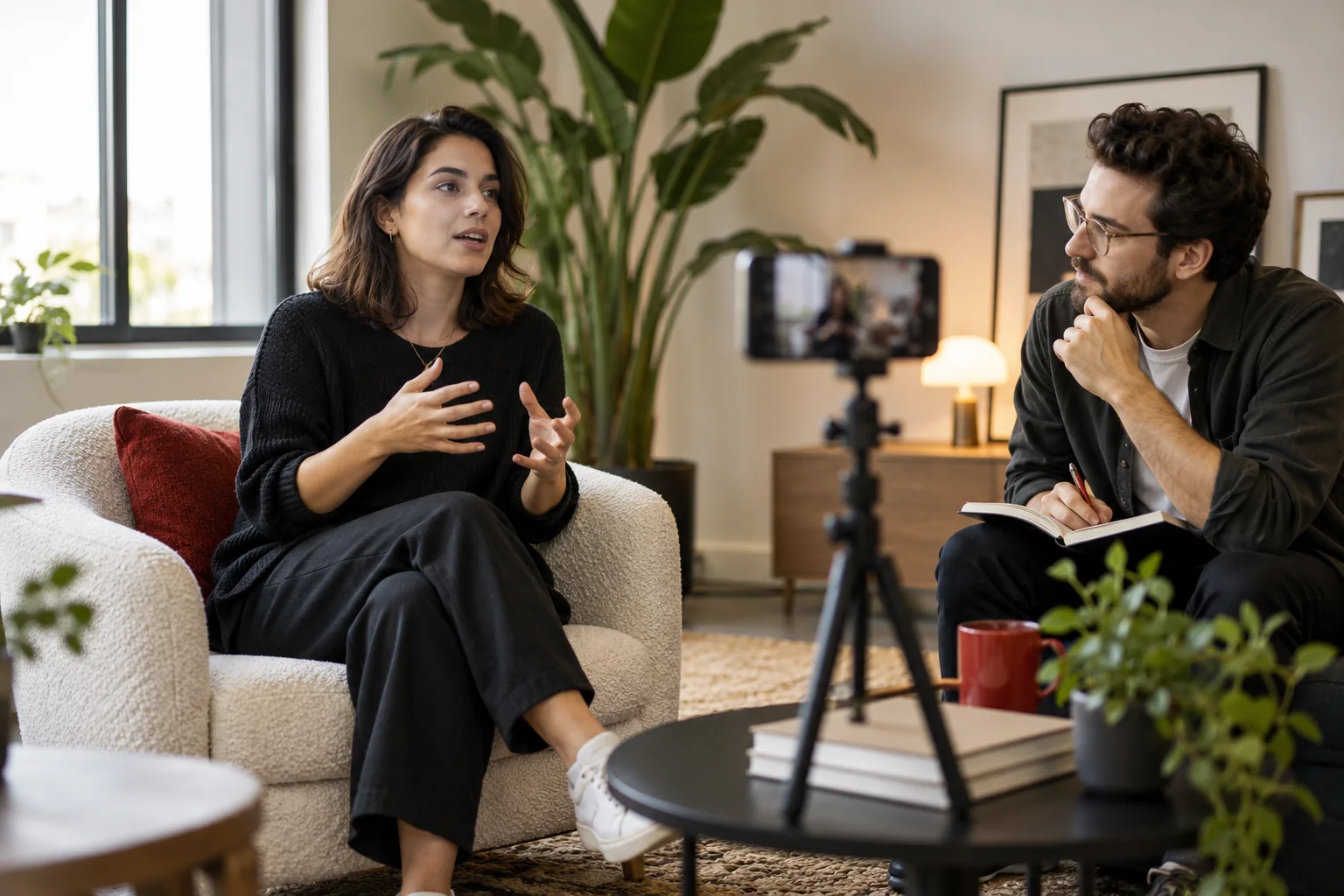
Some people come alive when another person asks a real question. A podcast-style session can provide that room. It is one option in the toolkit, not a compulsory interview process and not a reason to turn every client into a guest on a show. The content still begins with their point of view and the audience they want to help.
The best format may change with the topic. A personal lesson can benefit from a story. A technical distinction may be clearer straight to camera with a whiteboard or object. A nuanced opinion may need a longer conversation before it can be cut into a concise piece.

Give feedback someone can use
“Be more confident” is not direction. It asks someone to change an internal state without showing them what to do. Try feedback that points to an observable moment: “The example at 00:18 made the point clear,” “Start with that sentence,” or “Pause after the question; you rush into the explanation.”
After a take, review the message before reviewing the face. Can you identify the main point? Is there a moment where the speaker sounds especially clear? Is the example specific enough? Would a person in the audience know what to do next? Then decide whether another take is needed.
This shifts attention away from self-judgment and toward craft. It also gives a coach something concrete to improve: prompt, order, pace, example, framing, or length. Confidence can grow as a side effect of being able to see progress.
Keep conversation as an option
A relaxed conversation can help people stop performing for a lens. A good coach listens for the useful thread, asks a follow-up that opens it, and gives the speaker room to finish a thought. That is different from firing off a fixed list of interview questions and hoping the edit finds a personality afterward.
If conversation feels natural, use it. If it does not, try a direct take, a voiceover, or a simple demonstration. There is no requirement to make the most intimidating format your starting point. The goal is a repeatable way to share the idea clearly and honestly.
Run a small experiment you can learn from
A useful style test is short enough to finish and specific enough to compare. Choose one subject, one simple point, and two or three formats. Keep the recording setup similar. Give yourself a clear stopping time. This prevents a fifteen-minute experiment from turning into an afternoon spent changing lights and reviewing every expression.
Afterward, listen once without watching. Is the explanation easy to follow? Listen again with the picture on. Does the visual add anything? Then rate each take on three things: clarity, ease, and willingness to repeat it. Do not score your looks, accent, personality, or whether you resemble a professional presenter.
The best format is not always the easiest one in the first minute. A story can need a little thought before it feels natural. A direct explanation can become comfortable once you stop writing every word. Give each route a fair try, then choose the one that lets the audience hear the point and that you can imagine doing again next week.
Keep a note of the prompt and setup that helped. That is the beginning of your own recording playbook. Over time, you will know which topics want a story, which are easier to demonstrate, and when a conversation brings out a better answer.
Pick a starting format for the idea.
There is no permanent label here. Choose what fits this idea today; you can test another next time.
Test the same idea in more than one format. Keep the version that is clear and repeatable for you.